How to Calculate Line Speed for Palletizers
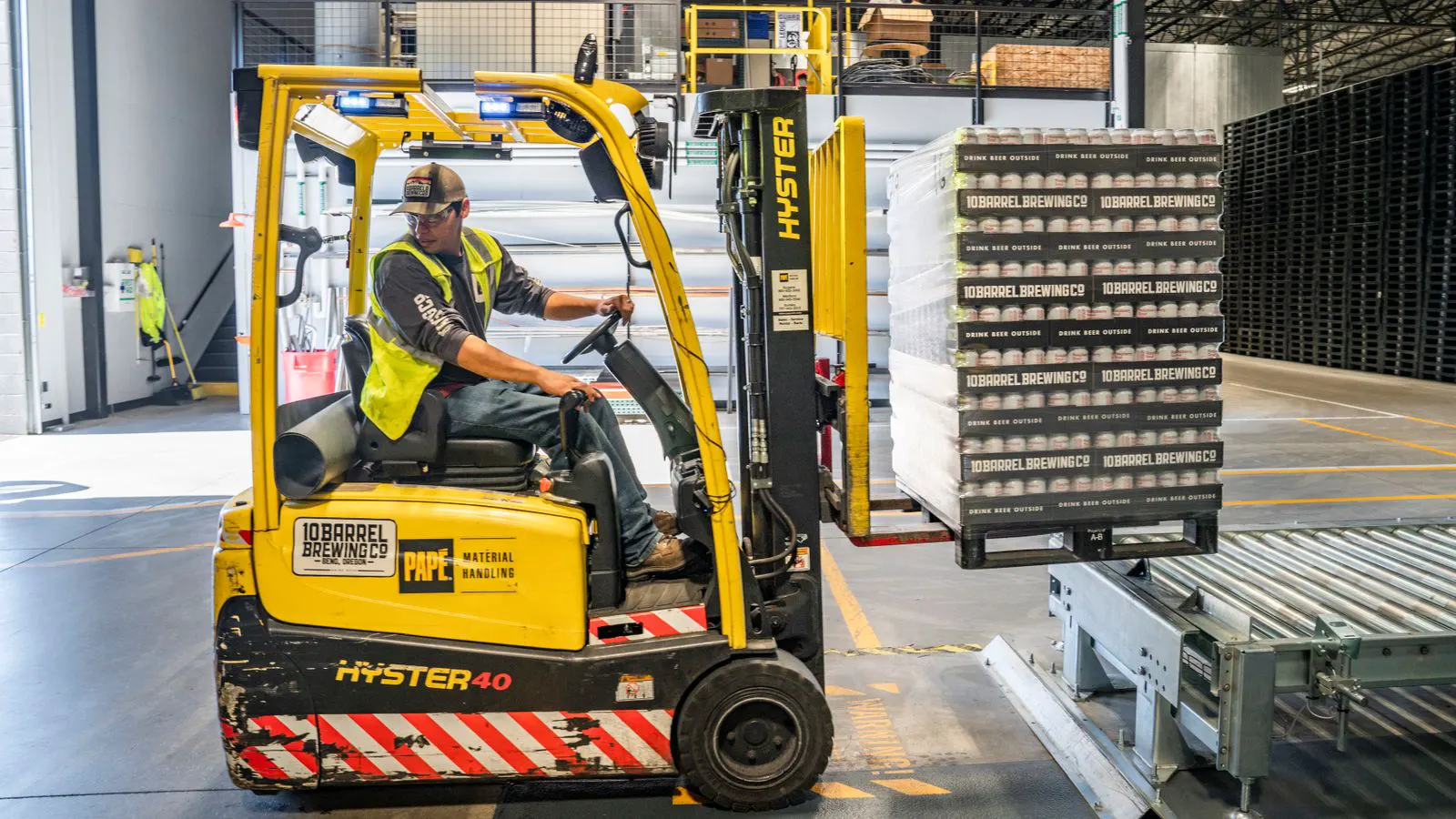
To determine the required palletizing machine speed, match the upstream case output to the pallet stack height and width. Use case stacking rates to identify the bottleneck and adjust the conveyor speed accordingly.
- Match the palletizer speed to the actual output of the upstream filling or case packing stations.
- Calculate the required cases per minute by dividing the pallet stack size by the cycle time.
- Account for case stacking rates and stack height limits to prevent jams and damage.
- Verify the final line speed using a time-based count of cases processed per minute.
Why Line Speed Must Match Upstream Flow
Line speed is not a single number. It is the result of balancing the output from upstream equipment with the mechanical limits of the palletizer. A filling line may produce 120 cases per minute, but the palletizer may only accept 90 cases per minute if the stack is too tall or the cycle time is too long.
When you calculate line speed, you are determining how fast the conveyor must move cases to the palletizer without creating a queue or starving the machine. The goal is a steady flow where every case is picked, placed, and the stack is built without interruption.
This section walks through the exact method to calculate line speed for palletizers. It covers prerequisites, the calculation steps, common mistakes, and a final verification method.
Prerequisites Before Calculation
Before you perform any math, gather the following data points. Without these, the calculated speed will be theoretical and may not reflect reality.
- Upstream case output: The maximum number of cases per minute the upstream station can produce. This is usually set by the filler or case packer.
- Pallet stack dimensions: The number of cases per row and the number of rows per layer.
- Total stack height: The number of layers per finished pallet.
- Case dimensions: The length and width of a single case.
- Palletizer cycle time: The time it takes the robot to pick one case and place it on the stack. This value comes from the machine specification sheet.
- Dwell time: The time the robot needs to reset between cycles, if specified.
If you do not have the exact cycle time, request it from the machine supplier. Do not guess. A two-second error in cycle time can change the required line speed significantly.
Step 1: Determine the Cases Per Layer
First, calculate how many cases fit in a single layer on the pallet. This depends on the pallet size and the case width.
Multiply the number of cases per row by the number of rows per layer. For example, if the pallet holds 6 cases across and 4 cases deep, the layer count is 24 cases.
This number is your base unit. Every layer you build requires this many cases. The palletizer picks and places cases one at a time, so the cycle time applies to each individual case.
Step 2: Calculate the Total Cases Per Pallet
Next, multiply the cases per layer by the total number of layers per pallet.
If the layer count is 24 and the pallet has 12 layers, the total cases per pallet is 288.
This number tells you how many individual picking cycles are needed to complete one pallet. The palletizer will execute this many cycles before the pallet is full and the next one is loaded.
Step 3: Calculate the Required Cases Per Minute
Now, divide the total cases per pallet by the palletizer cycle time to find the theoretical maximum throughput.
For example, if the cycle time is 3 seconds, the palletizer can process 20 cases per minute. If the upstream line produces 15 cases per minute, the palletizer is faster than the supply. If the upstream produces 25 cases per minute, the palletizer is the bottleneck.
The required line speed must not exceed the palletizer’s maximum throughput. It must also match the upstream output. If the upstream produces 15 cases per minute, the line speed should be set to 15 cases per minute.
Step 4: Account for Stack Height and Density
Taller stacks require more time to build. The robot must reach higher, and the case placement must be precise to maintain stability.
If the stack is near the maximum height, the cycle time may increase slightly due to reduced acceleration or slower placement. Check the machine manual for any height-based speed reductions.
Also consider case density. Soft or irregular cases may require a slower placement speed to avoid crushing or shifting. Hard, rigid cases can often be handled at full speed.
If you are unsure, start with the cycle time from the specification sheet and reduce it by 10 percent for soft cases. This creates a safety margin.
Step 5: Factor in Palletizer Dwell and Reset Time
Many palletizers have a brief pause between cycles to reorient the gripper or return the arm to the pick position. This is the dwell time.
Add the dwell time to the cycle time if it is not already included. For example, if the cycle time is 3 seconds and the dwell time is 1 second, the total cycle time is 4 seconds.
This reduces the maximum throughput. In the example above, the palletizer now handles 15 cases per minute instead of 20.
If the upstream line cannot keep up with this reduced rate, the line speed should be set to match the upstream output, not the palletizer maximum.
Step 6: Verify Conveyor and Palletizer Alignment
The line speed must also match the conveyor speed. If the conveyor moves faster than the palletizer can accept cases, a queue will form.
Calculate the conveyor speed in meters per minute or feet per minute based on the case length and the desired case spacing.
For example, if the case length is 300 mm and you want a spacing of 100 mm between cases, the conveyor speed must be set so that cases arrive at the palletizer in time for the next cycle.
Use the following formula:
Conveyor speed = (Case length + Case spacing) / Cycle time
If the case length is 0.3 meters, the spacing is 0.1 meters, and the cycle time is 4 seconds, the conveyor speed is 0.1 m/s.
Step 7: Run a Trial at 80 Percent of Calculated Speed
Do not start at full speed. Set the line to 80 percent of the calculated speed and run for 15 minutes.
Watch for the following:
- Cases piling up at the palletizer inlet.
- The palletizer arm moving slowly or pausing.
- Cases being dropped or shifted.
If the flow is smooth, increase the speed by 5 percent and run for another 15 minutes. Repeat until you reach the target speed or a problem appears.
If a problem appears, reduce the speed and identify the bottleneck. Is the upstream line too slow? Is the palletizer cycle time too long? Is the conveyor spacing too tight?
Common Mistakes in Line Speed Calculation
- Ignoring dwell time. Many engineers use only the cycle time from the spec sheet and forget the reset time. This overestimates throughput.
- Assuming upstream output is constant. If the upstream filler has a cycle time of 4 seconds but sometimes produces 5 seconds due to jams, the effective output is lower.
- Forgetting stack height limits. A tall stack may require a slower placement speed to prevent collapse.
- Not accounting for case variations. If cases are slightly larger than the design specification, the palletizer may need more time to align.
- Using theoretical speed instead of measured speed. Always verify with a time-based count during a trial run.
Final Verification Step
Run the line at the target speed for one full shift or at least 30 minutes. Count the number of cases processed and the number of pallets completed.
Calculate the actual cases per minute:
Actual throughput = (Number of cases processed) / (Number of minutes)
Compare this to the calculated throughput. If the actual is within 5 percent of the calculated, the line speed is correct.
If the actual is lower, identify the cause. Check the upstream output, the palletizer cycle time, and the conveyor speed. Adjust accordingly.
Document the final settings in your operating manual. Record the line speed, conveyor speed, cycle time, and stack configuration. This information is critical for future maintenance and production planning.
How Palletizer Throughput Relates to Case Stacking Rates
Palletizer throughput is the number of pallets completed per hour. Case stacking rates are the number of cases placed per minute. They are related but distinct.
If a pallet holds 288 cases and the palletizer operates at 15 cases per minute, one pallet takes 19.2 minutes to complete. In one hour, the palletizer completes approximately 3.1 pallets.
If you want to increase palletizer throughput, you can reduce the cycle time, reduce the stack height, or increase the upstream output. However, reducing the stack height may increase the number of pallets per hour but also increases handling time and pallet consumption.
Find the balance that matches your production volume and warehouse requirements.
Practical Example
Suppose you have a filling line that produces 120 cases per minute. The palletizer cycle time is 3 seconds, and the dwell time is 1 second. The total cycle time is 4 seconds.
The palletizer can handle 15 cases per minute. The upstream line produces 120 cases per minute. The palletizer is the bottleneck.
You cannot set the line speed to 120 cases per minute because the palletizer cannot accept that many. You must reduce the upstream output to 15 cases per minute or increase the palletizer speed.
If you increase the palletizer speed by reducing the cycle time to 2 seconds, the total cycle time becomes 3 seconds, and the throughput becomes 20 cases per minute. The upstream line still produces 120 cases per minute, so the palletizer is still the bottleneck.
You may need multiple palletizers or a faster palletizer to match the upstream output.
Checklist for Line Speed Validation
- Upstream case output measured in cases per minute.
- Palletizer cycle time and dwell time confirmed from the machine manual.
- Total cases per pallet calculated correctly.
- Stack height and case density considered.
- Conveyor speed calculated and set.
- Trial run at 80 percent of target speed completed.
- Actual throughput measured and compared to calculated throughput.
- Final settings documented in the operating manual.
Conclusion
Calculating line speed for palletizers requires matching upstream output to the palletizer’s mechanical limits. Use case stacking rates and cycle times to determine the maximum throughput. Account for dwell time, stack height, and case variations. Verify the final speed with a time-based trial run.
A correctly calculated line speed prevents queues, reduces jams, and maximizes production. Start with the data, follow the steps, and verify the results.
Frequently asked questions
How do I know if the palletizer is the bottleneck?
If the upstream line produces more cases per minute than the palletizer can accept, a queue will form at the palletizer inlet. Measure the upstream output and compare it to the palletizer throughput.
Can I increase line speed by reducing the stack height?
Yes, but it will increase the number of pallets per hour and the handling time. It may not increase total production if the bottleneck is elsewhere.
What if the case dimensions vary slightly?
Use the largest case dimension for your calculation. Add a safety margin to the cycle time if cases are irregular or soft.
How often should I recalculate line speed?
Recalculate whenever you change the palletizer, the stack configuration, or the upstream line speed. Also recalculate after any major maintenance or component replacement.
Is there a standard formula for line speed?
There is no single standard formula. The calculation depends on the specific machine and line configuration. The method described here is a general approach used in most B2B packaging lines.