What Is a Palletizing Machine and How It Works
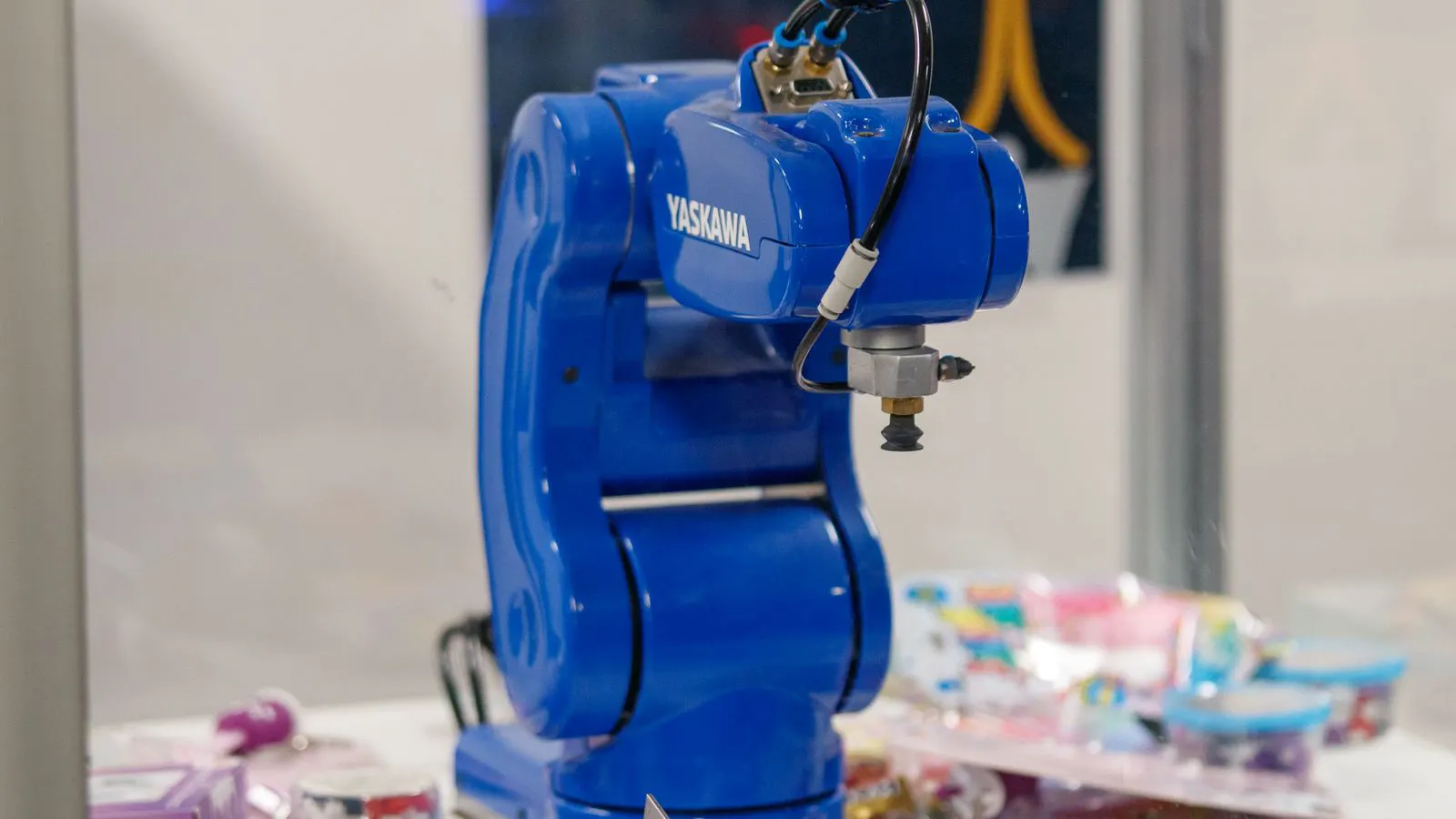
A palletizing machine stacks products onto pallets automatically. It uses a robot arm, sensors, and software to position each case or carton. Understanding its mechanics helps you define technical requirements before contacting suppliers.
- A palletizing machine replaces manual stacking with automated, repeatable placement of product units.
- The core components are the robot, the end effector, the pallet interface, and the vision system.
- Palletizer types differ by robot motion, speed, and how they handle varied case sizes.
- Sourcing decisions depend on product geometry, pallet dimensions, and throughput targets.
What is a palletizing machine
A palletizing machine moves product cases from a conveyor and stacks them onto a pallet. It replaces manual stacking with an automated process. The machine must place each unit with enough accuracy to keep the load stable for transport.
The machine works in two main phases. First, it takes a case from the supply conveyor. Second, it places that case on the pallet in a pattern. The pattern determines how the load is built. A good pattern leaves no gaps that shift during transit.
The term palletizer often refers to the robot and its control system. A full palletizing cell includes the robot, the pallet feeder, the case infeed conveyor, and the software that manages the sequence. When you specify a machine, you define the whole cell.
How the palletizing process works
The process starts when a case reaches the end of the supply conveyor. A sensor detects the case. The control system reads the case dimensions and orientation. The robot then moves to the case, grips it, and lifts it.
The robot carries the case over the pallet. A vision system looks at the top of the pile. It calculates where the next case fits best. The robot places the case. The cycle repeats.
The pallet itself usually moves on a turntable or a linear track. A turntable palletizer rotates the pallet while the robot stays fixed. A linear palletizer keeps the pallet still while the robot moves. Both methods work. The choice affects the layout of your warehouse.
The process relies on precise timing. If the case feed is too fast, the robot misses the case. If the pallet is not aligned, the stack can lean. The control system uses encoders and cameras to correct these errors.
Core components of a palletizer
The robot is the main actuator. It moves the case from the infeed to the pallet. Robots can be articulated, Cartesian, or SCARA. Articulated robots have a wide reach and can work over large pallet sizes. Cartesian robots are simpler and cheaper but have a smaller working envelope.
The end effector grips the case. It can be a vacuum cup, a suction plate, or mechanical fingers. Vacuum is common for smooth, rigid cartons. Fingers are used for soft packages or irregular shapes. The choice depends on the case material and size.
The vision system sees the case and the stack. It measures the case height and width. It also detects the pile height on the pallet. Without vision, the machine cannot stack uneven loads. It cannot handle mixed case sizes.
The pallet feeder brings the pallet to the robot. It can be a manual push, a conveyor, or a stacker. The pallet must be centered. If the pallet is off-center, the first row of cases will be off.
The control software manages the whole sequence. It stores the pallet pattern. It calculates the placement order. It handles errors, such as a case that does not fit. The software also logs data for maintenance and production tracking.
Palletizer types and how they differ
Palletizer types fall into two main groups. The first group is based on robot motion. The second group is based on how the machine handles the product.
The table below shows the main palletizer types and their typical applications.
| Palletizer Type | Robot Motion | Best For | Key Trade-off |
|---|---|---|---|
| Articulated | 6-axis jointed arm | Large pallets, varied case sizes | Higher cost, complex programming |
| Cartesian | Linear gantry | Narrow aisles, high speed | Limited reach, rigid structure |
| SCARA | Rotating arm | Fast cycle times, small cases | Limited vertical reach |
| Turntable | Fixed robot, rotating pallet | Standard pallet sizes | Pallet must rotate, takes floor space |
| Linear | Robot moves on linear axis | Long pallets, narrow floor space | Slower cycle time |
Turntable palletizers are the most common. The pallet sits on a rotating platform. The robot is fixed above it. As the pallet turns, the robot places cases in a spiral or a row. The rotation keeps the work area clear.
Linear palletizers are used when floor space is tight. The pallet is on a linear track. The robot moves back and forth above it. This setup works well in narrow aisles. It also works well when the pallet is very long.
The choice of type affects your sourcing decisions. If your warehouse has narrow aisles, a turntable may not fit. If your pallets are standard size, a linear palletizer may be slower than you need. Measure your floor. Measure your pallets. Then choose the type.
How product geometry affects the design
The shape of your product drives the machine design. A uniform case stack is easy to palletize. A mixed case stack is harder.
If all cases are the same size, the robot can use a fixed pattern. It does not need to measure each case. The vision system can be simpler. The cycle time can be faster.
If cases vary in size, the robot must measure each one. The vision system must calculate the best fit. This adds processing time. The pattern becomes dynamic. The software must decide where to put each case to keep the stack stable.
The height of the case matters too. Tall cases are harder to grip. They can tip if the robot moves too fast. The end effector must have a wide grip area. The robot must move slowly when lifting tall cases.
The weight of the case also matters. Heavy cases require a stronger robot. The end effector must handle the load without slipping. The pallet must be strong enough to support the full load.
When you specify a machine, describe your product in detail. List the case sizes. List the weights. List the materials. Show the robot the worst-case scenario. Do not assume the supplier will guess.
Sourcing and integration considerations
When you choose a supplier, you are buying a system, not just a robot. The system includes the software, the sensors, and the integration points.
The first thing to check is the communication protocol. The palletizer must talk to your line control. It must receive start and stop signals. It must send status data to your ERP or MES. Ask about the protocols. Ethernet/IP, PROFINET, and Modbus are common. Make sure they match your existing system.
The second thing to check is the vision system. Some machines use a single camera. Others use two cameras for better depth perception. Ask how the vision system handles uneven case stacks. Ask how it handles reflective case materials. Reflective cases can confuse cameras. A good system uses polarized lighting or multiple angles.
The third thing to check is the pallet handling. How does the pallet get to the robot? How does the finished pallet leave? If you use a conveyor, the palletizer must match the conveyor speed. If you use a manual push, the palletizer must have a buffer.
The fourth thing to check is the footprint. Measure the space above the pallet. The robot needs room to move. Measure the space in front of the infeed. The robot needs room to pick the case. Measure the space behind the pallet. The robot needs room to place the case.
The fifth thing to check is the service model. Ask about spare parts. Ask about remote support. Ask about training. A machine that is hard to service will cost you more in downtime. A machine with good documentation will save you time.
One worked example
Consider a plant that ships cases of 20 kg each. The cases are 60 cm wide, 40 cm deep, and 35 cm high. The pallets are standard 120 by 80 cm. The plant needs to ship 2,000 cases per hour.
The plant needs a palletizer that can handle these cases. The robot must lift 20 kg. The vision system must measure the 60 by 40 by 35 cm case. The palletizer must stack the cases on a 120 by 80 cm pallet.
A turntable palletizer with an articulated robot is a good fit. The robot can reach the whole pallet. The vision system can measure each case. The pallet rotates to bring the next spot to the robot.
The plant must check the floor space. The turntable takes up a circular area. The infeed conveyor must align with the robot. The finished pallet must be able to leave the cell.
The plant must also check the product stability. The cases are 20 kg each. The full pallet will be heavy. The robot must place the cases firmly. The vision system must ensure the stack is level.
This example shows the process. You define the product. You define the pallet. You define the throughput. You choose the machine type. You check the floor space. You check the integration.
Common mistakes to avoid
The first mistake is ignoring the case variation. If you tell the supplier that all cases are the same size, but the line sometimes runs a smaller case, the machine will fail. The vision system must handle the variation.
The second mistake is underestimating the floor space. The robot needs room to move. The pallet needs room to turn. The infeed conveyor needs room to align. Measure the space carefully. Do not guess.
The third mistake is choosing the wrong end effector. A vacuum cup works for a smooth case. It will not work for a soft case. A mechanical finger works for a soft case. It may be too slow for a high-speed line. Match the end effector to the product.
The fourth mistake is skipping the vision system. Without vision, the machine cannot stack uneven loads. It cannot handle mixed case sizes. It will build an unstable stack. The vision system is not optional. It is required for a reliable machine.
The fifth mistake is not planning for service. The robot will need maintenance. The vision system will need calibration. The software will need updates. Plan for this time. Do not assume the machine will run forever without attention.
Final checks before purchase
Before you buy, run a short list of checks.
- Confirm the case dimensions and weights.
- Confirm the pallet size and type.
- Confirm the throughput target.
- Confirm the floor space and ceiling height.
- Confirm the communication protocol.
- Confirm the vision system capability.
- Confirm the service and spare parts plan.
Run these checks with your supplier. Ask them to confirm each point in writing. A verbal promise is not a guarantee. A written specification is.
The palletizing machine is a system. It is not just a robot. It is a combination of hardware, software, and integration. When you understand how it works, you can ask the right questions. You can avoid costly mistakes. You can choose a machine that fits your line.
Frequently asked questions
What is the main difference between a turntable and a linear palletizer?
A turntable rotates the pallet under a fixed robot. A linear palletizer moves the robot on a track above a stationary pallet. The choice depends on floor space and pallet size.
Can a palletizer handle mixed case sizes?
Yes, if it has a vision system that measures each case. The software calculates the best fit for the stack. Without vision, the machine assumes all cases are the same size.
What is the role of the end effector?
The end effector grips the case. It can be a vacuum cup or mechanical fingers. The choice depends on the case material and shape. A wrong end effector will drop cases.
How much floor space does a palletizer need?
It depends on the robot type and pallet size. A turntable needs a circular area. A linear palletizer needs a long, narrow area. Measure the space before choosing a type.
Do I need a vision system?
Yes. The vision system measures the case and the stack. It ensures the stack is stable. It handles case variation. Without it, the machine will fail on uneven loads.